Aug. 4, 2023

2023 Housing Market Forecast: Price, Mortgage Rate & Sales Predictions [INFOGRAPHIC]

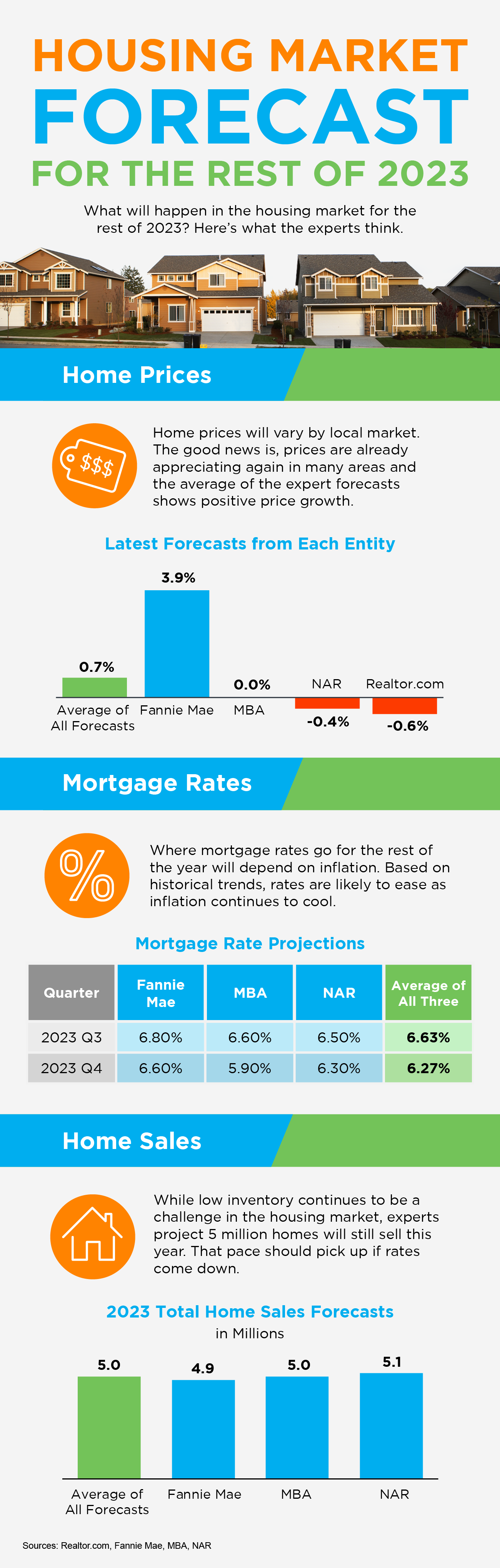
Housing Market Forecast for the Rest of 2023 [INFOGRAPHIC]


Some Highlights

  • Want to know what experts say will happen in the rest of 2023? Home prices are already appreciating again in many areas. The average of the expert forecasts shows positive price growth.
  • Where mortgage rates go for the rest of the year will depend on inflation. Based on historical trends, rates are likely to ease as inflation continues to cool.
  • Even though low inventory continues to be a challenge, experts project 5 million homes will still sell this year. That pace should pick up if rates come down.
Aug. 3, 2023

"Inflation and Its Impact on Mortgage Rates: What Homebuyers Need to Know in 2023

How Inflation Affects Mortgage Rates


When you read about the housing market in the news, you might see something about a recent decision made by the Federal Reserve (the Fed). But how does this decision affect you and your plans to buy a home? Here's what you need to know.

The Fed is trying hard to reduce inflation. And even though there’s been 12 straight months where inflation has cooled (see graph below), the most recent data shows it’s still higher than the Fed’s target of 2%: 

While you may have been hoping the Fed would stop their hikes since they’re making progress on their goal of bringing down inflation, they don’t want to stop too soon, and risk inflation climbing back up as a result. Because of this, the Fed decided to increase the Federal Funds Rate again last week. As Jerome Powell, Chairman of the Fed, says:

“We remain committed to bringing inflation back to our 2 percent goal and to keeping longer-term inflation expectations well anchored.”

Greg McBride, Senior VP, and Chief Financial Analyst at Bankrate, explains how high inflation and a strong economy play into the Fed’s recent decision:

“Inflation remains stubbornly high. The economy has been remarkably resilient, the labor market is still robust, but that may be contributing to the stubbornly high inflation. So, Fed has to pump the brakes a bit more.”

Even though a Federal Fund Rate hike by the Fed doesn’t directly dictate what happens with mortgage rates, it does have an impact. As a recent article from Fortune says:

“The federal funds rate is an interest rate that banks charge other banks when they lend one another money . . . When inflation is running high, the Fed will increase rates to increase the cost of borrowing and slow down the economy. When it’s too low, they’ll lower rates to stimulate the economy and get things moving again.”

How All of This Affects You 

In the simplest sense, when inflation is high, mortgage rates are also high. But, if the Fed succeeds in bringing down inflation, it could ultimately lead to lower mortgage rates, making it more affordable for you to buy a home.

This graph helps illustrate that point by showing that when inflation decreases, mortgage rates typically go down, too (see graph below): 

As the data above shows, inflation (shown in the blue trend line) is slowly coming down and, based on historical trends, mortgage rates (shown in the green trend line) are likely to follow. McBride says this about the future of mortgage rates:

“With the backdrop of easing inflation pressures, we should see more consistent declines in mortgage rates as the year progresses, particularly if the economy and labor market slow noticeably.”

Bottom Line

What happens to mortgage rates depends on inflation. If inflation cools down, mortgage rates should go down too. Let's talk so you can get expert advice on housing market changes and what they mean for you.

Aug. 2, 2023

Key Factors to Consider Before Buying Your First Home

How To Know If You’re Ready to Buy a Home


If you’re trying to decide if you’re ready to buy a home, there’s probably a lot on your mind. You’re thinking about your finances, today’s mortgage rates and home prices, the limited supply of homes for sale, and more. And, you’re juggling how all of those things will impact the choice you’ll make.

While housing market conditions are definitely a factor in your decision, your own life and your finances may be even more important. As an article from NerdWallet says:

“Housing market trends give important context. But whether this is a good time to buy a house also depends on your financial situation, life goals and readiness to become a homeowner.”

Instead of trying to time the market, it may help to focus on what you can control. Here are a few questions that can give you clarity on whether you’re ready to make your move.

1. Do You Have a Stable Job?

One thing to consider is how stable you feel your employment is. Buying a home is a big purchase, and you’re going to sign a home loan stating you’re going to pay that loan back. That can feel like a big obligation. Knowing you have a reliable job and income coming in can help put your mind at ease. As NerdWallet explains:

“A mortgage is a big commitment . . . Wait until your employment is stable before thinking about buying a house.”

2. Have You Figured Out What You Can Afford?

To make sure you have a good idea of what you’ll need to save and what you can expect to spend on your monthly payment, talk to a trusted lender. They’ll be able to tell you about the pre-approval process and what you can borrow, current mortgage rates and approximate monthly payments, closing costs to anticipate, what percent of the purchase price of the home you’ll need for a down payment, and more.

The best part is you may find out you’re closer to your goals than you realized. You don’t necessarily need to put 20% down, unless it’s specified by your lender or loan type. As Down Payment Resource says:

“A 20% down payment on a home is great, but . . . Many mortgages require no more than 3% to 5% of the purchase price as a down payment. Plus, there are loans and grants that may help cover these costs. Search for down payment assistance in your area, and discuss your results with your mortgage lender . . .”

3. How Long Do You Plan to Live There?

Another important thing to think about is how long you plan to stay put. It takes time to build equity in your home through paying down your loan and home price appreciation. If you plan to move too soon, you may not recoup your investment. For example, if you’re looking to sell and move again in a year, it might not make sense to buy right now. As a recent article from CNET says:

“Buying a home is a good idea if you’re planning to stay put for at least three years. Home values typically increase between 2% and 5% annually, so you could end up paying more in closing costs than you’d earn in proceeds if you sell after only a year or two.”

So, think about your future. If you plan to transfer to a new city with the upcoming promotion you’re working toward or you anticipate your loved ones will need you to move closer to take care of them, that’s something to factor in.

Above all else, the most important question to answer is: do you have a team of real estate professionals in place? If not, finding a trusted local agent and a lender is a good first step.

Bottom Line

If you’re trying to decide if you’re ready to buy a home, these questions can help. But ultimately, your best and more reliable resource is the help of trusted real estate professionals.

Aug. 1, 2023

Overcoming Home Selling Obstacles in 2023: Mortgage Rates and Inventory Concerns


Many homeowners thinking about selling have two key things holding them back. That’s feeling locked in by today’s higher mortgage rates and worrying they won’t be able to find something to buy while supply is so low. Let’s dive into each challenge and give you some helpful advice on how to overcome these obstacles.

Challenge #1: The Reluctance to Take on a Higher Mortgage Rate

According to the Federal Housing Finance Agency (FHFA), the average interest rate for current homeowners with mortgages is less than 4% (see graph below):

But today, the typical 30-year fixed mortgage rate offered to buyers is closer to 7%. As a result, many homeowners are opting to stay put instead of moving to another home with a higher borrowing cost. This is a situation known as the mortgage rate lock-in effect.

The Advice: Waiting May Not Pay Off

While experts project mortgage rates will gradually fall this year as inflation cools, that doesn’t necessarily mean you should wait to sell. Mortgage rates are notoriously hard to predict. And, right now home prices are back on the rise. If you move now, you’ll at least beat rising home prices when you buy your next home. And, if experts are right and rates fall, you can always refinance later if that happens.

Challenge #2: The Fear of Not Finding Something to Buy

When so many homeowners are reluctant to take on a higher rate, fewer homes are going to come onto the market. That’s going to keep inventory low. As Lawrence Yun, Chief Economist at the National Association of Realtors (NAR), explains:

“Inventory will remain tight in the coming months and even for the next couple of years. Some homeowners are unwilling to trade up or trade down after locking in historically-low mortgage rates in recent years.”

Even though you know this limited housing supply helps your house stand out to eager buyers, it may also make you feel hesitant to sell because you don’t want to struggle to find something to purchase.

The Advice: Broaden Your Search

If fear you won’t be able to find your next home is the primary thing holding you back, remember to consider all your options. Looking at all housing types including condos, townhouses, and even newly built homes can help give you more to choose from. Plus, if you’re able to work fully remote or hybrid, you may be able to consider areas you hadn’t previously searched. If you can look further from your place of work, you may have more affordable options.

Bottom Line

Instead of focusing on the challenges, focus on what you can control. Let’s connect so you’re working with a professional who has the experience to navigate these waters and find the perfect home for you.

July 31, 2023

Importance of Right House Pricing in Today's Market - Expert Agent Advice

Pricing Your House Right Still Matters Today


While this isn’t the frenzied market we saw during the ‘unicorn’ years, homes that are priced right are still selling quickly and seeing multiple offers right now. That’s because the number of homes for sale is still so low. Data from the National Association of Realtors (NAR) shows 76% of homes sold within a month and the average saw 3.5 offers in June.

To set yourself up to see advantages like these, you need to rely on an agent. Only an agent has the expertise needed to find the right asking price for your house. Here’s what’s at stake if that price isn’t accurate for today’s market value.

The price you set for your house sends a message to potential buyers.

Price it too low and you might raise questions about your home’s condition or lead buyers to assume something is wrong with it. Not to mention, if you undervalue your house, you could leave money on the table, which decreases your future buying power.

On the other hand, price it too high and you run the risk of deterring buyers from ever touring it in the first place. When that happens, you may have to do a price drop to try to re-ignite interest in your house when it sits on the market for a while. But be aware that a price drop can be seen as a red flag for some buyers who will wonder why the price was reduced and what that means about the home.

A recent article from NerdWallet sums it up like this:

"Your house’s market debut is your first chance to attract a buyer and it’s important to get the pricing right. If your home is overpriced, you run the risk of buyers not seeing the listing . . . But price your house too low and you could end up leaving some serious money on the table. A bargain-basement price could also turn some buyers away, as they may wonder if there are any underlying problems with the house."

Think of pricing your home as a target. Your goal is to aim directly for the center – not too high, not too low, but right at market value.

Pricing your house fairly based on market conditions increases the chance you’ll have more buyers who are interested in purchasing it. That makes it more likely you’ll see multiple offers too. Plus, when homes are priced right, they still tend to sell quickly.

To get a high-level look into the potential downsides of over or underpricing your house and the perks that come with pricing it at market value, see the chart below:

Lean on a Professional’s Expertise to Price Your House Right

So why is an agent essential in finding the right price? Your local agent has the skill and the insight necessary to find the market value of your home. They’ll use their expertise to determine a realistic listing price by assessing:

  • The prices of recently sold homes
  • The current market conditions
  • The size and condition of your house
  • The location of your house

Bottom Line

Pricing your house at market value is critical, so don’t rely on guesswork. Let’s connect to make sure your house is priced right for today’s market.

July 28, 2023

Top 7 Homebuyer Regrets & How to Avoid Them - Expert Homebuying Guide

August-2023-MVP-Blog-Post-Image


7 Common Homebuyer Regrets (And How To Avoid Them)

To avoid buyer’s remorse, be sure to consider your future self when shopping for a home. 

Most new homebuyers don’t regret becoming homeowners. In fact, according to a survey by LendingTree, 80% of recent buyers who successfully overcame a challenging housing market say they’re glad they found their current homes.1 But that doesn’t mean newly-minted homeowners don’t have any regrets about their buying choices. 

On the contrary, research shows that even the most-satisfied homeowners would change some aspects of their home purchase if given the opportunity. According to a recent survey by Anytime Estimate, nearly 3 out of 4 buyers who purchased a home in 2021 or 2022 still have a few regrets.2 

Some question their decision to move to a neighborhood they still don’t love. Others wish they had been less picky about where they lived so they could have paid less. Many are afraid they overspent or think they sacrificed too much in their rush to buy a home. 

Here are some of the most common homebuyer regrets we see, along with our professional advice on how to avoid them.


REGRET #1: Spending More Than Necessary 

No one wants to overpay for their new home purchase (and, luckily, with the right guidance, doing so is avoidable). But even if you’ve secured a winning purchase price, there are still plenty of ways to accidentally overspend. 

One of the most common ways to overpay? Choose the wrong mortgage. In fact, in today’s higher-rate environment, this can be one of the riskiest mistakes a new buyer can make. 

According to a recent survey, for example, nearly three-quarters of homebuyers leave money on the table by not bothering to shop around for the best rate.3 And research by LendingTree suggests that buyers in major metro areas lose an average of $63,151 over the life of their loan just by picking the first mortgage they’re offered.4

Lesson Learned:  As long as you stick to what you can afford, buying a home can be a boon for your financial health. The longer you live in it, for example, the more your home is likely to appreciate in value and boost your long-term savings. 

But to get the most value from your purchase, it’s worth your time to compare financing options and shop around for the best deal. We also recommend getting a mortgage pre-approval before you start your home search so you know what’s within reach. We can refer you to one of our trusted lending partners for help.


REGRET #2: Rushing Into a Home Purchase

In a competitive housing market, it’s often necessary to act fast to secure a home. But don’t let a need for speed tempt you into making an offer before you’ve thought through or fully vetted a new property.   

Rushing into a home purchase isn’t just risky, it’s also one of the most commonly cited sources of homebuyer regret. According to Anytime Estimate, for example, more than 1 in 4 homebuyers felt remorse over how quickly they sped through the home buying process.2 

Getting swept away by your emotions can also lead to buyer’s remorse. If you’ve found a home you love and are competing with other buyers, it can be tempting to overlook key details or bid more than you can afford. That’s one reason it helps to have a skilled professional by your side to calmly guide you through the process and ensure you act with reason, rather than emotion.

Lesson Learned:  Buying a home is exciting. But if you don’t keep your emotions in check or act too impulsively, you could make poor choices in the moment that are hard to undo later. 

To avoid making last-minute decisions that could backfire, know what you want, what you need, and what you can afford before you start your home search. We can help you set priorities so you’ll be able to move forward with confidence when the time is right.


REGRET #3: Miscalculating the Costs of Homeownership

Though real estate is a great long-term investment, it can be pricey in the short-term, often surprising homeowners who aren’t prepared for it. According to some estimates, for example, annual maintenance could cost as much as 1% or more of your home’s purchase price.5 Some buyers also forget to factor in additional ownership expenses, such as property taxes, insurance, and repairs.

Failing to think through the costs of homeownership is one of the most common sources of homebuyer regret. According to Anytime Estimate, for example, nearly half of the homebuyers who regret their purchase said they underestimated how much they would spend to live in it.2

However, some homes cost more to live in and maintain than others. So even if you’re certain that you can afford the average cost of homeownership, that doesn’t necessarily mean that every home in your price range will fit neatly into your budget. For example, very old homes with unique maintenance requirements could be extra pricey to keep up. Similarly, homes with high HOA or condo fees could also eat into your monthly budget. 

Lesson Learned:  A home should help you build your wealth, not drain it. So it’s important to factor in all the potential costs of living in a home—not just obvious ones like your mortgage payment and taxes. To ensure you don’t get overextended, add up your estimated maintenance and repair costs, as well as any miscellaneous expenses that are unique to a particular home. 

We can help you with these estimates—and, if needed, present you with some less-costly alternatives.


REGRET #4: Underestimating the Time Required To Maintain or Renovate a Home

One of the most joyful aspects of homeownership is getting to relax in a home that’s all your own. But if a home is too high maintenance, then you may not have time to savor it. 

Many homeowners love to spend their weekends puttering in their gardens or undertaking home improvement projects. But if that’s not you, then you may not like living in a home with a big yard or with high-maintenance features, like a pool.

According to a survey by Hippo, for example, 47% of homeowners who feel some regret about their home purchase complain that too much maintenance and upkeep is required.6 

Similarly, buyers who purchase fixer-uppers are often surprised by how much time it takes to rehab their new homes. Although buying a fixer-upper is a great way to save on the purchase price, you could come to resent it if it eats up all your free time.

Lesson Learned:  Renovation and maintenance projects are often time-consuming and stressful. So beware of committing to a property that requires too much of your attention if you don’t have the time or patience for it. With that said, home improvement projects can also bring a lot of joy and satisfaction to owners who like rolling up their sleeves.

We can talk through the realities of homeownership with you and help you choose a property that will fit your personality and schedule.


REGRET #5: Ignoring or Skipping a Home Inspection

It’s easy to get swept up in the excitement of buying a home. Sometimes, buyers will agree to skip a home inspection to sweeten their offer in a competitive market. They may also be tempted to pinch pennies since they’re already facing a large outlay. However, if you skip out on a home inspection, you could come to regret it.

When you hire a home inspector, you get a professional, in-depth examination of the property’s structures and systems before you buy it. It’s a worthwhile investment that can save you money in the long run, either by warning you away from a bad purchase or by providing a list of deficiencies you can use to negotiate with the sellers. 

But even the most thorough home inspection isn’t going to be worth much if you don’t take the time to carefully consider it. If at all possible, make sure you’re on-site during the inspection so you can observe and ask questions. And don’t forget to re-evaluate any repairs that the seller agrees to make to ensure they’ve been properly completed prior to closing.

Lesson Learned:  A home inspection can reduce your risk and save you money in the long run. But to maximize its effectiveness, you will need to be an active participant in the process.

We’d be happy to share a list of experienced and trustworthy home inspectors in our area. And when the inspection report is complete, we can help you decide if the purchase is worthwhile and negotiate any relevant seller concessions and repairs.


REGRET #6: Choosing a Home That Doesn’t Fit 

Homeownership is often a better investment if you’re willing to stay put for at least five years.7 But if your newly purchased home isn’t a good fit, then you may not want to stick around that long. 

Many homeowner complaints come down to simple lifestyle issues: Although a mismatch may seem small at first, the problems can magnify if you make so many compromises that they interfere with your quality of life.

Or, sometimes homebuyers can fall in love with a beautiful home and forget about practicalities. For example, a stunning kitchen can’t replace a needed bedroom or bathroom. And a sparkling pool may sit empty if the home requires a lengthy commute to your office.

Make sure you set some guardrails during your home purchase so you don’t over-compromise or accidentally prioritize your wants over your needs.

Lesson Learned:  When you’re dealing with limited inventory or a fixed budget, it may be necessary to sacrifice some items on your home wish list. But if you fail to secure your must-haves, you could come to regret your home choice.

We can help you avoid an ill-fitting home purchase by working with you to set (and stick to) priorities and parameters before you begin your search. 


REGRET #7: Purchasing Without Professional Help

Another path to homebuyer regret? Foregoing the expert guidance and market insight that you can only get from a licensed real estate agent.

Buying a home without professional representation can be extremely risky. Therefore, it’s no surprise that 86% of buyers enlist the help of an agent when purchasing a home. And the vast majority find their assistance to be invaluable: 89% say they would use their agent again or recommend them to others.8

Real estate is hyperlocal and extremely fluid—especially these days when the market is in constant flux. So it pays to have a knowledgeable expert by your side who can guide you through an often-complicated process. 

We can help you avoid expensive mistakes that could lead to buyer’s remorse, all while making your home purchase as seamless and stress-free as possible. And since the home seller typically pays our commission, there’s no added expense for you!

Lesson Learned:  When you work with a real estate agent, you benefit from a wealth of expertise and on-the-ground insight that you can’t get anywhere else. We’ll help you steer clear of the missteps that so many homebuyers make, so you can focus on enjoying your new home instead of questioning your choices down the road.

The best part? Since the majority of home sellers pay us a commission at closing, in most cases, we offer our invaluable guidance and assistance at no additional cost to you!


BOTTOMLINE

No one wants to look back on their home purchase and realize they made a big mistake. We can help you avoid the pitfalls so you can buy with confidence. To learn more about how we work to ensure our clients’ satisfaction, reach out today to schedule a free consultation.


The above references an opinion and is for informational purposes only.  It is not intended to be financial, legal, or tax advice. Consult the appropriate professionals for advice regarding your individual needs.


Sources:

  1. LendingTree –
    https://www.lendingtree.com/home/mortgage/homebuying-process-survey/
  2. Anytime Estimate –
    https://anytimeestimate.com/research/american-home-buyers-2022/
     
  3. Zillow Home Loans –
    https://zillow.mediaroom.com/2022-11-18-Prospective-home-buyers-spend-about-as-much-time-researching-new-TVs-as-they-do-mortgage-lenders
     
  4. LendingTree –
    https://www.lendingtree.com/home/mortgage/mortgage-shopping-study/
  5. CNBC –
    https://www.cnbc.com/2022/05/01/survey-majority-of-homeowners-have-regrets.html
  6. Hippo –
    https://www.hippo.com/blog/2022-hippo-housepower-report-how-homeowners-are-responding-essential-maintenance-during
  7. Realtor.com –
    https://www.realtor.com/advice/sell/how-soon-can-you-sell-a-house-after-buying/
     
  8. National Association of Realtors –
    https://www.nar.realtor/research-and-statistics/research-reports/highlights-from-the-profile-of-home-buyers-and-sellers#homebuyers
July 27, 2023

2023 Housing Market Trends: Why Buyer Activity Remains Strong

Homebuyers Are Still More Active Than Usual


Even though the housing market is no longer experiencing the frenzy that was so characteristic of the last couple of years, it doesn’t mean today’s market is at a standstill. In actuality, buyer traffic is still strong today.

The ShowingTime Showing Index is a measure of how much buyers are touring homes. The graph below uses that index to illustrate buyer activity trends over time to help put today into the proper perspective.

It shows there’s seasonality in real estate. If you look at the last normal years in the market (shown in gray), there was a consistent pattern as buyer activity peaked in the first half of each year (during the peak homebuying season in the spring) and slowed as each year came to a close.

When the pandemic hit in March of 2020, that trend was disrupted as the market responded to the resulting uncertainty (shown in blue in the middle). From there, we entered the ‘unicorn’ years of housing (shown in pink). This is when mortgage rates were record-low and buyer demand was sky high. Similar seasonal trends still existed even during that time, just at much higher levels.

Now, let’s look at 2023. Traffic is down from the previous month and it’s also lower than the peaks we saw in the ‘unicorn’ years. But what’s happening isn’t a steep drop off in demand – it’s a slow return toward more normal seasonality. As the ShowingTime report explains:

“Showing traffic declined about 10% in May . . . This follows a typical seasonal pattern – disrupted by the pandemic but now beginning to return . . .”

And, to highlight this isn’t a drastic decline, let’s zoom in. Here’s a graph using just the May data for the last five years. It shows just how strong buyer demand still is.

What Does That Mean for You?

Buyers are still out there touring homes. They’re more active than they were in May 2022 (when sticker shock over higher mortgage rates started to set in) and certainly more than they were in the last normal years. So, remember, buyer activity is still strong. And it could actually be even stronger if it wasn’t constrained by the limited supply of homes for sale. According to U.S. News:

“Housing markets have cooled slightly, but demand hasn’t disappeared, and in many places remains strong largely due to the shortage of homes on the market.”

Bottom Line

Don’t lose sight of just how active the market still is today. If your house isn’t on the market, it’s not getting in front of all those buyers who are looking to make a purchase right now. Let’s connect to start the process.

July 26, 2023

Expert Tips to Navigate Competitive Home Buying in 2023

Tips for Making Your Best Offer on a Home

July 26, 2023


While the wild ride that was the ‘unicorn’ years of housing is behind us, today’s market is still competitive in many areas because the supply of homes for sale is still low. If you’re looking to buy a home this season, know that the peak frenzy of bidding wars is in the rearview mirror, but you may still come up against some multiple-offer scenarios.

Here are a few things to consider to help you put your best foot forward when making an offer on a home.

1. Lean on a Real Estate Professional

Rely on an agent who can support your goals and help you understand what’s happening in today’s housing market. Agents are experts in the local market and on national trends too. They’ll use both of those areas of expertise to make sure you have all the information you need to move with confidence.

Plus, they know what’s worked for other buyers in your area and what sellers may be looking for in an offer. It may seem simple, but catering to what a seller needs can help your offer stand out. As an article from Forbes says:

"Getting to know a local realtor where you’re hoping to buy can also potentially give you a crucial edge in a tight housing market."

2. Get Pre-Approved for a Home Loan

Having a clear budget in mind is especially important right now given the current affordability challenges. The best way to get a clear picture of what you can borrow is to work with a lender so you can get pre-approved for a home loan.

That’ll help you be more financially confident because you’ll have a better understanding of your numbers. It shows sellers you’re serious, too. And that can give you a competitive edge if you do get into a multiple-offer scenario.

3. Make a Fair Offer

It’s only natural to want the best deal you can get on a home. However, submitting an offer that’s too low does have some risks. You don’t want to make an offer that will be tossed out as soon as it’s received just to see if it sticks. As Realtor.com explains:

“. . . an offer price that’s significantly lower than the listing price, is often rejected by sellers who feel insulted . . . Most listing agents try to get their sellers to at least enter negotiations with buyers, to counteroffer with a number a little closer to the list price. However, if a seller is offended by a buyer or isn’t taking the buyer seriously, there’s not much you, or the real estate agent, can do.”

The expertise your agent brings to this part of the process will help you stay competitive and find a price that’s fair to you and the seller.

4. Trust Your Agent’s Expertise Throughout Negotiations

During the ‘unicorn’ years of housing, some buyers skipped home inspections or didn’t ask for concessions from the seller in order to submit the winning bid on a home. An article from Bankrate explains this isn’t happening as often today, and that’s good news:

“While the market has largely calmed down since then, sellers are still very much in the driver’s seat in this era of scarce housing inventory. It’s not as common for buyers to waive inspections anymore, but it does still happen. . . . It’s in the buyer’s best interest to have a home inspected . . . Inspections alert you to existing or potential problems with the home, giving you not just an early heads up but also a useful negotiating tactic.”

Fortunately, today’s market is different, and you may have more negotiating power than before. When putting together an offer, your trusted real estate advisor will help you think through what levers to pull and which ones you may not want to compromise on.

Bottom Line

When you buy a home this summer, let’s connect so you have an expert on your side who can help you make your best offer.

July 24, 2023

My Home Didn’t Sell! Now What?

Are you a homeowner stuck with a property that hasn’t sold? Maybe your listing expired, or you withdrew it from the market because the lack of progress so disheartened you. Or perhaps you tried to sell your home on your own with no results.

If that’s you, you’re in the right place! Read this guide to learn…

 The top five reasons a home doesn’t sell

  •  

 Action steps to overcome each of these issues

  •  

This marketing piece is not intended as a solicitation for properties currently in an exclusive agreement with another Broker.

Reason #1: Bad Timing

If your home didn’t sell after several months on the market, timing could’ve been a factor. Markets are driven by the law of supply and demand, and real estate is no exception.

When demand outpaces supply, it’s considered a seller’s market and homes get snapped up quickly. In a buyer’s market, however, there are more homes for sale than active buyers. This can cause homes to sell for less money and to sit on the market for a longer period of time before receiving an offer.

Now What?

In most cases, buyers can be motivated to act with a combination of improvements, incentives, and pricing. If you suspect timing played a role in your inability to sell, consult with a knowledgeable real estate agent. We can estimate how long a home like yours should take to sell given current market conditions.

Mark Bigelow
If you suspect timing played a role in your inability to sell, consult with a knowledgeable real estate agent.
Reason #2: Ineffective Marketing

Did your home get a steady stream of showings when it was on the market? If not, you may need to try a new promotional strategy.

Take a look at your listing description and photos. A clear description and high-quality photos are crucial. Many buyers use these to decide whether or not to visit your home. Another factor to consider is whether your listing reached the right audience. Some properties require a more robust marketing approach to be found by the most interested buyers.

Now What?

If you suspect ineffective marketing, consider turning to a skilled professional with a proven approach. We employ the latest technologies to seed the marketplace, optimize for search engine placement, and position your home for the best possible impression right out of the gate.

Want to learn more? View our complete Property Marketing Plan.

Mark Bigelow
If you suspect ineffective marketing, consider turning to a skilled professional with a proven approach.
Reason #3: Poor Impression

If your property received a lot of foot traffic but no offers, you may need to examine the impression you made on buyers who visited your property.

Start with your home’s structure and systems. Are there any “red flags” that could’ve scared away buyers, such as large cracks in the foundation or water stains on the ceiling? What about neglected maintenance and repairs? Finally, was your home properly prepped to maximize its appeal? A clean and decluttered space helps buyers more easily picture themselves living in your home.

Now What?

When we take on a new listing, we always walk through it with the homeowner and point out any steps that should be taken to boost its sales potential. In some cases, we will recommend that you utilize staging techniques that are shown to help homes sell faster and for more money. We can help you determine the appropriate budget and effort required to get your home sold.

Mark Bigelow
We can share tips on how to prep your property before each showing to maximize its sales potential.
Reason #4: Price Is Too High

It’s possible your home’s original asking price was set using sales data from before a market shift. But regardless of the economic climate, pricing a home is always tricky because so many factors can impact how much buyers are willing to pay.

Many homeowners are reluctant to drop their listing price. But the reality is, buyers may not seriously consider your property if they think your home is overpriced. If your home sat on the market for months without an offer, then chances are good that your asking price needs to be reevaluated.

Now What?

If you aren’t in a rush to sell, adjustments to timing or marketing may bring in a new pool of potential buyers. And repairs, upgrades, and staging can increase the perceived value of your home, which may be enough to bring a buyer to the table at your original list price.

However, if you need to sell quickly, or you’ve already exhausted those options, a price reduction may be necessary to get your home the attention it needs. We can help you determine a realistic asking price given today’s market conditions.

Mark Bigelow
We can help you determine a realistic asking price for your home given today’s market conditions.
Reason #5: You Hired the Wrong Agent (Or No Agent At All)

If you suspect that your previous real estate agent didn’t do enough—or used the wrong approach—to sell your home, you’re not alone. Many sellers whose listings languish until they expire or are withdrawn feel this way.

Or, perhaps you chose not to hire a listing agent at all and have been trying to sell your home yourself. That can be an equally frustrating experience—and research shows it can actually cost you time and money in the long run.

Now What?

If either of those scenarios sounds familiar, we should talk. By now, you owe yourself more than the status quo when it comes to your real estate representation. Our multi-step Property Marketing Plan can help you sell your home for the most money possible, and in the process reconnect you with the excitement you originally felt upon first listing. It’s time for a new agent, new marketing, new buyers, and most of all… new possibilities.

Mark Bigelow
It’s time for a new agent, new marketing, new buyers, and most of all... new possibilities.
Posted in Market Updates
July 20, 2023

Homeownership as a Wealth-Building Tool in 2023

Owning Your Home Helps You Build Wealth


You may have heard some people say it’s better to rent than buy a home right now. But, even today, there are lots of good reasons to become a homeowner. One of them is that owning a home is typically viewed as a good long-term investment that helps your net worth grow over time.

Homeownership Builds Wealth Regardless of Income Level

You may be surprised to learn homeowners across various income levels have a much higher net worth than renters who make the same amount. Data from First American helps illustrate this point (see graph below):

What makes wealth so much higher for homeowners? A recent article from Realtor.com says:

“Homeownership has long been tied to building wealth—and for good reason. Instead of throwing rent money out the window each month, owning a home allows you to build home equity. And over time, equity can turn your mortgage debt into a sizeable asset.”

Basically, the wealth you accumulate when you own a home has a lot to do with equity. As a homeowner, equity is built up as you pay down your loan and as home prices appreciate over time. Mark Fleming, Chief Economist at First American, explains how this same benefit isn’t true for renters in a recent podcast:

“Renters as non-homeowners gain no wealth benefit as home prices rise. That wealth actually accrues to the landlord.”

Before you decide to sign another rental agreement, now is a good time to think about whether it would be better for you to buy a home instead. The best way to figure out what makes sense for you is to have a conversation with a real estate expert you trust. That professional can talk you through the benefits that come with owning to determine if that’s the right next step for you. 

Bottom Line

If you're not sure whether to keep renting or to buy a home, know that owning a home, no matter how much money you make, can help build your wealth. Let's connect now to get started on the path to homeownership.