
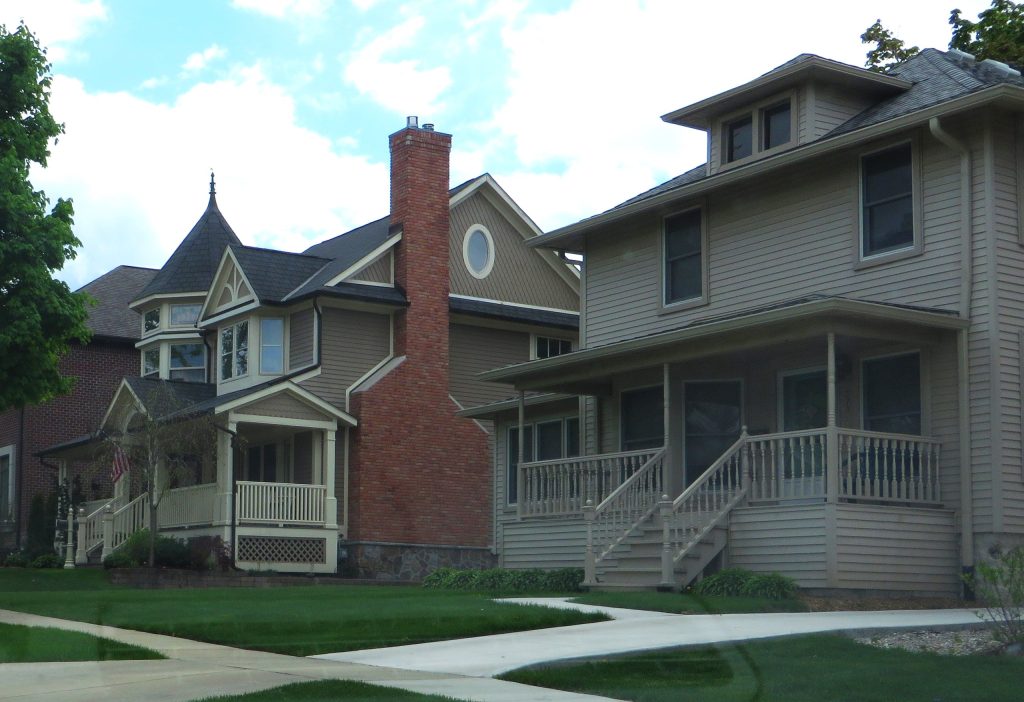
The tax bill on the listing sheet belongs to the seller. On the average Oakland County home, the buyer's taxable value is about 40% higher the year after the sale. Here is how the reset works, what it costs on a median-priced home in Royal Oak and Troy, when the new bill arrives, and the three forms that decide it.
By BIG Real Estate · Statutes and county documents verified October 25, 2026
If you are shopping for a home in Oakland County, the property-tax figure on the listing is one of the least reliable numbers you will see. It is what the current owner pays, and the current owner's bill is protected by a cap on taxable value that has been compounding since they bought. When you close, the cap resets.
The county's own figures show how large that gap has become. Across Oakland County's 345,481 improved residential parcels, the average 2025 assessed value was $204,513 and the average taxable value was $146,421, according to the Oakland County Equalization Division's residential summary. Taxable value, the number the tax rate is actually applied to, sits 28% below assessed value on the average home. After a sale, the two become equal. For the average parcel that is a 40% increase in the tax base before anyone changes a millage rate.
This article explains how the reset works under Michigan law, what it means in dollars at the county's September median sale price of $383,500, when the higher bill shows up, which transfers escape it, and what 2027 is likely to bring. It is general information drawn from statute and county documents, not advice about a specific parcel.
How Michigan caps property taxes, and why a sale removes the cap
Michigan taxes property on taxable value, not market value. Since Proposal A passed in 1994, the General Property Tax Act has limited the annual increase in a parcel's taxable value to the lesser of 5% or the rate of inflation, as long as the property does not change hands and nothing is added to it. The inflation figure, called the inflation rate multiplier, is set each year by the Michigan State Tax Commission using a formula written into MCL 211.34d. For 2026 it is 1.027, a 2.7% increase, per the Commission's Bulletin 14 of 2025. In 2023 and 2024, when inflation ran above 5%, the cap held increases to 5%.
Assessed value, by contrast, tracks the market. Michigan's Constitution requires property to be assessed at no more than 50% of its usual selling price; after county and state equalization, that figure becomes the state equalized value, or SEV. Oakland County assessors reset it every year using a two-year sales study (for 2026 assessments, sales from April 2023 through March 2025), as the county's 2026 Guide to Property Taxes and Proposal A explains.
Over a long ownership the two numbers drift far apart. Metro Detroit home prices, measured by the S&P CoreLogic Case-Shiller index, rose 86% between September 2016 and June 2026. Over the same ten tax years the cap allowed a continuously owned home's taxable value to rise about 31%. County-wide, residential taxable value in 2026 is $67.5 billion against $93.8 billion of state equalized value, according to the 2026 Equalization Report; the tax base is 72 cents on the dollar of assessed value.
A sale closes that gap in one step. Under MCL 211.27a(3), when ownership transfers, the property's taxable value for the following calendar year becomes that year's state equalized value. The county guide puts it plainly: if you purchase property, your taxable value for the following year will be the same as the SEV. The cap then starts again from the new, higher base, until the next sale.
What it costs on a median-priced home
Suppose a buyer closes this fall on a home at $383,500, the Oakland County median sale price in September according to Realcomp (we covered that market report here). Assume the assessor's 2027 state equalized value lands at half the price, $191,750. That is a planning assumption, not a rule: assessors are not permitted to set a home's assessment at its individual sale price, and the actual SEV comes from the neighborhood sales study. It can land above or below half the price.
Now apply the millage. Total certified 2025 rates for an owner-occupied home with a Principal Residence Exemption come from the Oakland County 2025 Apportionment Report:
- Royal Oak (Royal Oak schools): 37.9610 mills. On a $191,750 taxable value, about $7,279 a year, or $607 a month. The city's 2025 rate sheet adds a 1% administration fee, so call it $7,350.
- Troy (Troy School District): 36.0430 mills. About $6,911 a year, or $576 a month, before any local administration fee.
Compare that with the seller. If the seller's parcel matched the county average, with taxable value at 71.6% of assessed value, their taxable value would be about $137,300. In Royal Oak that is roughly $5,210 a year. The buyer pays about $2,070 more a year, or $170 a month, for the same house, the same services and the same millage rate. In Troy the difference is about $1,960. At the current 7.32% mortgage rate, $170 a month is the payment on roughly $25,000 of additional loan principal. Buyers who are stretching to qualify should treat the tax reset as part of the price.
Two more points on the millage. First, the numbers above assume the buyer will live in the home and claim the Principal Residence Exemption. A rental or second home in Royal Oak pays the non-exempt rate of 54.9301 mills, about $10,530 on the same taxable value. Second, rates differ by city and by school district within a city. Southfield, Birmingham, Ferndale and the other communities in our area each have their own certified totals, and the City of Troy alone contains several school districts with different rates. Look up the exact combination for the address in the county's apportionment report, or ask us to run it.
When the higher bill arrives
Michigan assesses property based on its status on December 31, the state's "tax day." Close on any date in 2026 and the uncapping applies to the 2027 tax year. The sequence runs like this:
- February 2027: the city or township mails an assessment change notice. The county's guide to the notice says that if you bought in the previous calendar year, assessed and taxable value should be equal on it.
- March 2027: the local Board of Review meets, starting on the second Monday in March in most communities. This is the only window to appeal the assessed value for the year. If you paid $383,500 for a home assessed as though it were worth $420,000, this is when you say so, with your closing statement and comparable sales in hand.
- Summer 2027: the first tax bill at the new taxable value. Oakland County communities bill twice a year, in summer and winter, and the summer bill carries most of the levy.
One consequence of the calendar is worth knowing. A buyer who closes in late December 2026 is uncapped for 2027. A buyer who closes in early January 2027 is not uncapped until 2028, and pays the seller's capped taxable value for all of 2027. At the county-average gap that is roughly $2,000. It is not a reason to delay a purchase that otherwise makes sense, but if a December or January closing date is negotiable, the difference is real.
A related trap is the mortgage escrow. Lenders commonly set the initial escrow payment from the most recent tax bill, which is the seller's. When the first uncapped bill arrives, the escrow account runs short and the monthly payment rises, sometimes by a few hundred dollars, in the second year. Ask the lender to base the escrow on your estimated uncapped taxes from the start.
Three forms that decide your first bill
1. The Property Transfer Affidavit. State law requires the buyer to notify the local assessor within 45 days of the transfer, on the State Tax Commission's form (Treasury Form L-4260), stating the parties, the date, the price and the parcel number. Miss it and MCL 211.27b imposes a penalty of $5 a day up to $200 for a principal residence (up to $4,000 for other property), and the uncapping is applied retroactively with interest once the assessor finds the sale. Title companies usually prepare the affidavit at closing; confirm it was actually filed.
2. The Principal Residence Exemption affidavit. Under MCL 211.7cc, a home you own and occupy as your principal residence is exempt from the local school operating levy, which state law caps at 18 mills. In Royal Oak the exemption is worth about 17 mills, or roughly $3,250 a year on our example. The exemption does not transfer with the house; the new owner files their own affidavit (Treasury Form 2368). File by June 1 to have it apply to that year's summer bill, or by November 1 for the winter bill. File it the week you close and the deadline takes care of itself.
3. For sellers who have not sold yet: the conditional rescission. A move-up buyer who closes on the new home before selling the old one would normally lose the exemption on the old house within 90 days of moving out. The same section of law lets an owner keep the exemption on the former home for up to three tax years if it is not occupied, is listed for sale, is not leased and is not used for business, by filing a conditional rescission form with the city or township that collects the tax. We covered the rest of the selling side, including transfer taxes and the disclosure statement, in our fall selling guide.
Transfers that do not uncap
Not every change of name on a deed is a "transfer of ownership" for tax purposes. MCL 211.27a(7) excludes, among others:
- Transfers between spouses, or from a deceased owner to a surviving spouse.
- Since December 31, 2014, transfers of residential property to the owner's (or the owner's spouse's) parent, sibling, child, adopted child or grandchild, as long as the property is not used for a commercial purpose afterward. A home passed from parent to child, by sale, gift or inheritance, keeps its capped taxable value.
- Certain transfers into and out of trusts where the beneficiary is the settlor, the settlor's spouse or one of the relatives above.
- Property subject to a retained life estate, until the life estate ends.
Conveyances that do count include an ordinary deed, a land contract, a lease of more than 35 years, and the transfer of more than half the ownership of a company that holds the property. If you are buying from a relative, or considering putting a home into a trust or an LLC, the tax consequence depends on the exact structure. That is a question for a real estate attorney or tax professional before the paperwork is signed, not after.
If you're building: how the cap works on new construction
Buying a lot and building adds a second layer to all of this. The land transfer uncaps the land's taxable value the following year, exactly like any other sale. The house is treated differently: under MCL 211.34d it is an "addition" — "property not in existence on the immediately preceding tax day" — and additions enter the roll at their assessed value, not at a capped figure. In practice the assessor values whatever is standing on the lot on Tax Day, December 31, and a half-built house is typically valued at its percentage of completion. That value joins your taxable value the next year, and the inflation cap only applies from there.
The budgeting trap is timing. Close on a lot in the spring, finish the house in the fall, and your first bills reflect land plus whatever was complete on December 31 — the full bill on the finished home arrives the year after completion. Lenders set your escrow from the bills that exist at closing, so the payment can jump sharply 12 to 24 months in, often with a shortage to make up. Ask the builder and the lender to estimate taxes on the finished value at the current millage rate, and set money aside against that number rather than the current bill.
Buying a completed spec home from a builder is simpler but has the same blind spot. The purchase is a transfer, so taxable value resets to the state equalized value the following year. But the "last year's taxes" figure on the listing may reflect only the land, or a partially built structure, which can be a fraction of what you will owe. Treat it as a floor, not an estimate.
Three more things new-construction owners should know. First, file the Principal Residence Exemption affidavit (Form 2368) as soon as you occupy the home — the June 1 and November 1 deadlines apply to new builds too, and without it the school operating levy of up to 18 mills applies. Second, new subdivisions often carry special assessments for roads, sewer or water that are billed separately and are not subject to the cap; ask for the assessment roll before you sign. Third, if you renovate instead of build, the Mathieu-Gast Act (MCL 211.27(2)) keeps normal repairs and maintenance out of your assessment until you sell, but genuine additions — new square footage, a finished basement, a garage — count as new construction and are added at assessed value.
What 2027 is likely to bring
For owners who stay put, the question each fall is the next year's inflation rate multiplier. The State Tax Commission issued the 2026 figure on November 18, 2025, and the bulletin typically arrives in November. The statute defines the multiplier as the average Consumer Price Index for October 2025 through September 2026 divided by the average for October 2024 through September 2025.
Using the Bureau of Labor Statistics data as published through FRED, the first eleven months of that period average 330.76 against 319.997 for the prior year, a ratio of 1.0336. The twelfth month is a problem: BLS never published an October 2025 CPI because of the federal shutdown, and it has said it will not collect that month's data retroactively. Filling the gap with the average of September and November gives a ratio of about 1.032. Our estimate, therefore, is a 2027 multiplier of roughly 1.032 to 1.034, a 3.2% to 3.4% increase, higher than this year's 2.7% but well under the 5% ceiling. How the Commission handles the missing month is its decision, and this is our calculation, not an official figure. We will update this article when the bulletin is published.
For a buyer, next year's multiplier is a rounding error next to the reset. The owner next door will see taxable value rise about 3%; yours will rise to meet the SEV. Millage rates also move. The 2025 apportionment shows "Headlee" rollbacks trimming several local rates (Troy's city levy fell from 9.8640 to 9.7919 mills, the Royal Oak schools' levy on principal residences from 4.3045 to 4.2215) while new voted millages raised others. Check whether anything is on your community's November ballot.
What this analysis cannot tell you
- Your actual SEV. We assumed half the purchase price. The assessor's sales study may produce a different number, especially for new construction, heavily renovated homes and condominiums. The current SEV and taxable value for any parcel are public record at the city or township assessor's office.
- Special levies. Our totals exclude special assessments and district levies such as Royal Oak's 1.6003-mill downtown district.
- Future millage changes. Rates are certified each year and change with rollbacks, expirations and ballot proposals.
- Your specific transaction. Land contracts, trusts, inherited property, partial interests and business entities all have their own rules under the statute.
A short checklist for buyers
- Estimate your taxes as half the purchase price times the principal-residence millage for the exact city and school district, not from the listing.
- Ask your lender to set the escrow on that estimate.
- Confirm the Property Transfer Affidavit is filed within 45 days of closing.
- File the Principal Residence Exemption affidavit the week you close (June 1 deadline for the summer bill).
- Read the February assessment notice and appeal to the March Board of Review if the assessed value exceeds half of what the home would actually sell for.
- If a December or January closing is negotiable, understand that the date decides whether 2027 or 2028 is your first uncapped year.
- If the seller is a relative, or a trust or company is involved, get professional advice on whether the transfer uncaps at all.
The takeaway
In Michigan the seller's tax bill is a history lesson, not a forecast. On the average Oakland County home the taxable value rises about 40% the year after a sale, which on a median-priced house in Royal Oak or Troy means roughly $2,000 a year more than the seller paid, around $170 a month. The amount is knowable before you write an offer: half the price, times the certified millage for the address, plus a short list of forms and deadlines that are easy to meet if you know they exist.
This article is general information about Michigan property tax law, not legal, tax or financial advice for any specific property or transaction. Consult a qualified professional about your situation. Statutes cited are from the Michigan Legislature's website; millage rates are 2025 certified rates from Oakland County's Apportionment Report and the City of Royal Oak; county values are from the Oakland County Equalization Division; the 2027 multiplier estimate is BIG Real Estate's calculation from Bureau of Labor Statistics data and is not an official figure. All sources retrieved October 25, 2026.